


Addressing Empathy in Online ELE Activities
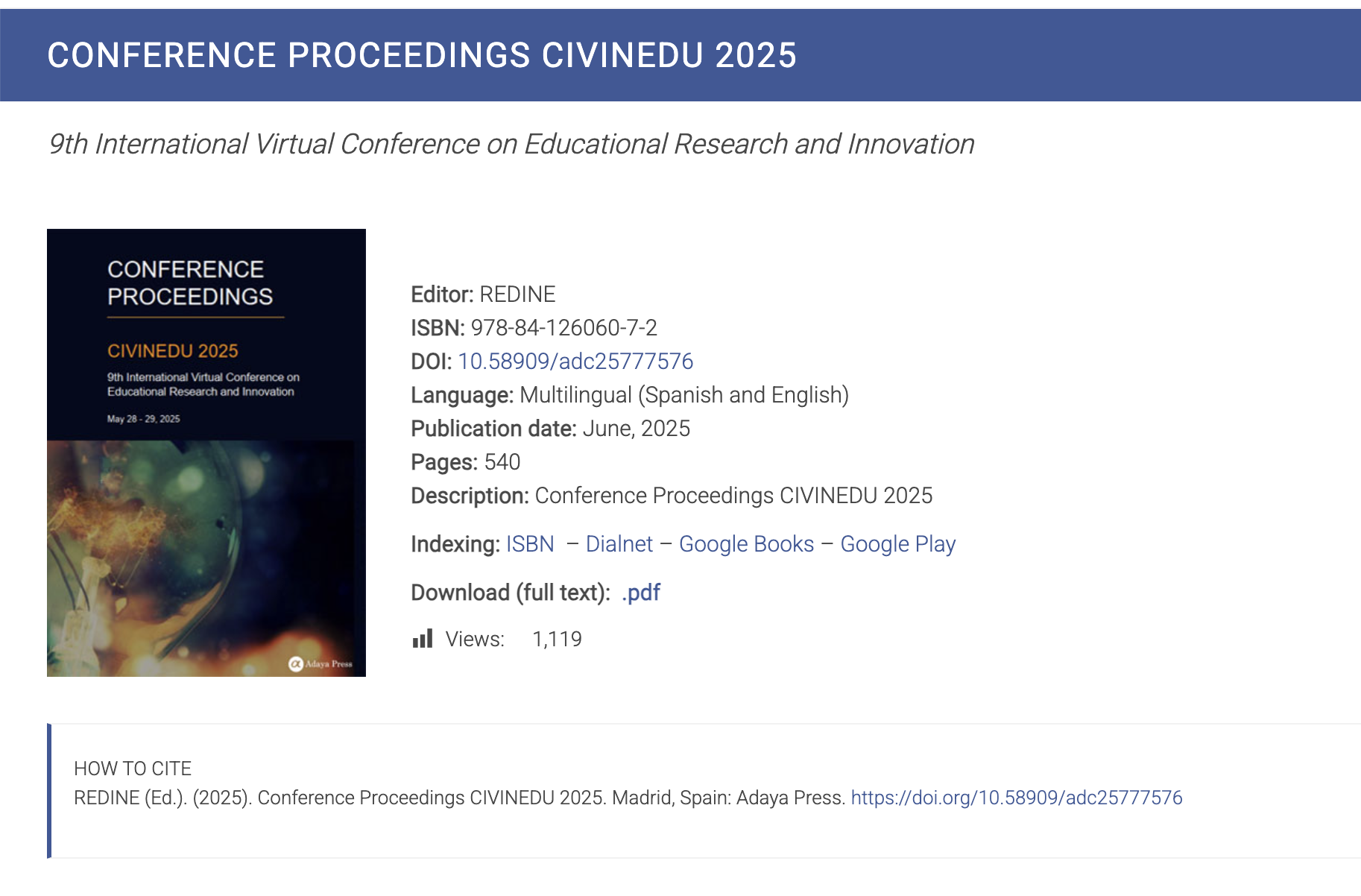
Delgado García, A. (2025). Addressing Empathy in Online ELE Activities. En Conference Proceedings. 9th International Virtual Conference on Educational Research and Innovation. Madrid: REDINE, Adaya Press. ISBN: 978-84-126060-7-2, e-ISSN: 3045-7300 pp. 308-311. https://www.adayapress.com/conference-proceedings-civinedu-2025/
Abstract
This paper presents a pedagogical experience carried out in an online classroom of Spanish as a Foreign Language (ELE) at the Ural Federal University (UrFU) in Russia, during the COVID-19 pandemic lockdowns starting in March 2020. The focus lies on online learning and grammar reinforcement activities, framed within a global media and health crisis. A central component involved writing and sending letters of encouragement to Spanish hospital patients—titled “From Russia with Love.” These letters, written in Spanish, were part of a broader educational aim: cultivating empathy and solidarity among Russian translation students while reinforcing language acquisition in real-life communicative contexts.
Keywords: education, ELE, Spanish as a Foreign Language, virtual teaching.
Resumen
Se presenta la experiencia trabajada en un aula de alumnado de español lengua extranjera, en la Universidad Federal de los Urales, Rusia, con motivo de los confinamientos sanitarios realizados a partir de marzo del 2020. Concretamente se trabajan actividades online de aprendizaje y refuerzo de la gramática española, y de ejercicios prácticos vinculados con la realidad sanitaria y mediática vivida mundialmente. Para ello se relatan las actividades de realizar cartas de apoyo y ánimo a enfermos de hospitales españoles, redactadas y enviadas “desde Rusia con amor”. Se aprovecharon las sinergias de estudiantes de traducción del idioma español de una universidad federal rusa, que quisieron sumarse a transmitir su empatía y solidaridad con las numerosas víctimas del Coronavirus en hospitales españoles, a través de cartas elaboradas en español donde demostraron su adquisición de la lengua que estudiaban.
Palabras clave: docencia virtual, educación, ELE, español lengua extranjera.
Introduction
This study summarizes the teaching and learning experience developed at the Ural Federal University, Russia, during the 2019–2020 academic year, specifically within the fourth-year Spanish course for Translation majors. Initially delivered in-person, the course shifted entirely online in March 2020 following national lockdown mandates due to the SARS-CoV-2 outbreak.
This sudden transition prompted a reflection on the challenges faced by ELE groups accustomed to in-person methodologies. The focus shifted to how these students—familiar with using digital materials merely as support tools—adapted to fully virtual learning. A core initiative involved students composing letters addressed to anonymous patients hospitalized in Spain during the initial waves of the pandemic. These activities served both pedagogical and humanistic purposes: maintaining educational continuity while awakening a sense of transnational empathy and shared human experience through language.
Context
Teaching, whether in-person or virtual, shapes how students and teachers relate to each other, often fostering emotional closeness through human interaction. In traditional classrooms, face-to-face dynamics allow for spontaneous gestures, eye contact, and body language. With the shift to online platforms—Zoom, Skype, Collaborate, LarkSuite—those channels became limited, and rebuilding emotional connections required new strategies.
To address this, we encouraged students to connect emotionally with Spanish-speaking individuals affected by the same global crisis. Though they were physically distant and culturally distinct, the pandemic’s shared impact provided a bridge. The language of instruction—Spanish—became the conduit not only for learning grammar but for expressing compassion, solidarity, and humanity.
Digital literacy among these students was already high, which made it feasible to integrate internet-based tasks into lessons. Activities were adapted to reflect current events, and vocabulary lessons were enriched with terms from real-world health scenarios. Students were introduced to regional varieties of Spanish through social media, news outlets, and government communications—building a broad and diverse lexical field relevant to the global moment.
Letters as a Pedagogical Tool
One innovative activity designed to address the emotional distance imposed by the pandemic was the writing of anonymous letters to COVID-19 patients in Spanish hospitals. This initiative had both an academic and humanitarian dimension. Inspired by campaigns led by Spanish healthcare institutions (ConSalud, 2020), students were tasked with researching hospital contact information, reading about the campaigns in Spanish, and crafting heartfelt messages to patients they would never meet.
This served multiple goals: it developed their internet research skills in Spanish, reinforced grammar and syntax for emotional expression, and fostered empathy. Even more, it provided a real-world communicative context for their Spanish—a foreign language used here not for abstract exercises but to comfort actual people (Delgado García, 2024).
The experience was particularly powerful because it echoed historical precedents familiar to Russian students. During World War II, Soviet citizens—especially in the Urals—sent encouraging letters to frontline soldiers. Drawing on this cultural memory helped students internalize the emotional power of such gestures, now directed not at soldiers, but at fellow human beings facing medical battles in isolation. The inclusion of elements of their history and cultural identity helped to generate bonds of affection with the activities to be carried out (Delgado García, 2024).
Methodology
The activity was carried out with fourth-year Translation students aged 21 to 23, who had studied Spanish for three years. It spanned two months and was incorporated into grammar units focused on expressing wishes, emotions, and formal writing. Emphasis was placed on intercultural understanding and the social function of language (Níkleva & López-García, 2016).
To ensure the experience was meaningful, students were introduced to historical and cultural parallels between Russia and Spain. For instance, the Soviet tradition of writing to soldiers during wartime was used to draw connections with the act of writing to COVID patients. References to Marshal Zhukov’s native region, Sverdlovskaya, underscored how similar collective efforts had supported morale in earlier crises. This background deepened students’ understanding and gave personal resonance to their letters.
The students were guided to express hope, encouragement, and solidarity—employing grammatical structures suitable for formal and emotional writing. The combination of cultural memory, linguistic skill, and current global events made for a powerful educational intervention that transcended traditional lesson plans.
Results and Discussion
Amid the global tragedy of the COVID-19 pandemic, one educational “opportunity” was the chance to contextualize Spanish grammar through real-world application. Core content from A2–B1 levels, as outlined by the Common European Framework of Reference for Languages, CEFR(MECD, 2012), was reframed using pandemic-related materials.
Students analyzed news reports, public health bulletins, and hygiene guidelines in Spanish—texts they were familiar with in their native language, but now had to interpret and use in a foreign tongue. These included communications from Spanish health ministries and media outlets, which served as both linguistic input and socio-cultural learning tools (MSCBS, 2020).
The ultimate goal was not only linguistic proficiency but also the cultivation of general communicative competence—applying Spanish in daily life, academic contexts, and future professional settings. For translation students, learning the nuances of emotional, formal, and medical vocabulary offered practical preparation for careers involving real-time interpretation or written translation across disciplines.
Moreover, writing anonymous letters encouraged students to shift from abstract learning to deeply personal expression. They had to imagine themselves in the patients’ situation, using the target language to convey empathy and encouragement. This turned out to be a mutual feedback loop: the students learned how to engage in digital Spanish-language environments, and the recipients—though anonymous—received genuine words of support.
Beyond grammar and vocabulary, students developed digital competencies such as sourcing reliable Spanish-language materials, navigating institutional websites, and producing coherent messages with emotional clarity. In short, the shift to online learning did not halt the educational process—it enriched it.
Conclusion
This teaching experience shows how a sudden shift to virtual learning can evolve into a meaningful, hybrid approach that combines traditional and digital methods. Far from weakening the classroom dynamic, the pandemic enabled a deeper exploration of how language connects people emotionally, socially, and culturally.
The initiative bridged geographical and emotional distances through the Spanish language. It demonstrated that even during confinement, learners can engage authentically with the world—and that emotional connection is not only possible in foreign language education but essential.
This case supports the future use of blended learning (b-learning), an approach long discussed in educational literature (Pino, 2008; Cabero, 2006), which merges e-learning with conventional face-to-face instruction. Far from discarding virtual tools post-pandemic, this experience suggests their potential for enhancing empathy, social responsibility, and linguistic competence. As such, it offers a viable model for future ELE instruction that is both humanistic and technologically current.
References
Cabero, J. (2006). Bases pedagógicas del e-learning. Revista de Universidad y Sociedad del Conocimiento, (RUSC) 3 (1), 1-10.
Delgado García, A. (2023). “Ingredientes de la imagen país en manuales de docencia del Español como Lengua Extranjera, ELE”. Revista Científica De La Facultad De Filosofía, 18(2), 375–388. ISSN: 2414-8717. https://doi.org/10.57201/rcff.v18i2.3752
Delgado García, A. (2024). Aprendizaje y empatía en alumnos de español lengua extranjera, ELE, actividades para crear lazos de afectividad a través de la virtualidad. Beoiberística: Revista de Estudios Ibéricos, Latinoamericanos y Comparativos, Vol. 8 (2024) No. 1, 18. pp. 291-305. ISSN 2560-4163 https://doi.org/10.18485/beoiber.2024.8.1.18
MECD, Ministerio de Educación, Cultura y Deporte, (2012). Marco Común Europeo de referencia para las Lenguas: Aprendizaje, Enseñanza, Evaluación. Madrid: MECD.
MSCBS, Ministerio de Sanidad, Consumo y Bienestar Social, (2020), Preguntas y respuestas. Visto el 3 de octubre del 2023, disponible en https://www.mscbs.gob.es/profesionales/saludPublica/ccayes/alertasActual/nCov-China/ciudadania.htm
Níkleva, D. G., López-García, Mª. P. (2016). “Introducción a la enseñanza del español para inmigrantes: dimensiones didácticas e interculturales”. Espiral, Cuadernos del Profesorado. Septiembre 2016, 9(19), 31-43.
Pino M. (2008). Aplicaciones de herramientas de e-learning a la docencia presencial. Revista de Formación e Innovación Educativa Universitaria, 1 (4). 87-95.