


RECURSOS D'APRENENTATGE
-
CHRISTMAS COUNTING CHALLENGE

Recurso para trabajar los números del 1 al 5 en lengua inglesa para la etapa de Educación Infantil. Contiene tres tareas que envuelven el conteo de diferentes elementos navideños.
Àrea de coneixementContext educatiuTipus de recurs -
SOLVING EQUATIONS AND PROBLEMS WITH EQUATIONS
Continuar enseñando al alumno Algebra con las ecuaciones de 2ºgrado y la resolución de problemas.
Àrea de coneixementContext educatiuTipus de recurs -
Trigonometry
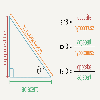
Con este recurso se pretende introducir la Trigonometría por medio de una actividad en el exterior. La idea original está tomada de una actividad colgada en TES Education.
Àrea de coneixementContext educatiuTipus de recurs -
"FUNDAMENTAL GEOMETRIC FIGURES"

Animated comic, made for the Nooc @comic_INTEF
Àrea de coneixementContext educatiuTipus de recurs -
3d-shapes. CLIL MATH LESSON
Unidad didáctica CLIL de geometría
Àrea de coneixementContext educatiuTipus de recurs -
Radians per second
¿A cuántos radianes por segundo va la bola azul?
Àrea de coneixementContext educatiuTipus de recursColecciones -
Math´s Gymkhana at "Parque de María Luisa" Sevilla
Unidad didáctica interdisciplinar mediante metodología AICLE para 3º ESO Matemáticas aplicadas bilingüe
Àrea de coneixementContext educatiuTipus de recurs -
Pythagoras' Theorem

This unit focuses on Pythagoras' theorem and how to prove it is true.
Àrea de coneixementContext educatiuTipus de recursColecciones -
Operations with integers - II

In this unit, we revise the basic ideas of integers and we use them to practise the following operations: sum, multiplication, division and powers. Before starting this unit, students should have studied integers in class in the traditional way. These activities are suitable as a complement to get a better understanding of the concepts and the operations. The numbers that appear in each window are generated at random. This allows you to use the window indefinitely and practise a lot of differ...
Àrea de coneixementContext educatiuTipus de recursColecciones -
Simultaneous equations and inequations

Solving equations, simultaneous equations and inequations belongs to the branch of mathematics called Algebra. These equations are often used in the field of science to assist with their most important task: that of solving problems. Throughout the history of mathematics numerous mathematicians have dedicated many years of study to the procedures needed to solve equations and simultaneous equations. In this unit we focus on quadratic or higher degree equations, linear and quadratic simultaneo...
Àrea de coneixementContext educatiuTipus de recursColecciones -
Analytical Geometry

In this unit we will approach the study of the straight line in a plane considering thoroughly the necessary concepts to do so. We will be working with numerical and geometric elements to find algebraically the concepts associated with the study in a plane. In some places geometry will be contemplated where it can be shown how an analytical method can be used to simplify geometric concepts.
Àrea de coneixementContext educatiuTipus de recursColecciones -
Continuity and discontinuities

This unit deals with the concept of continuity of functions. It carries on from previous units which dealt with limits of functions and the properties of these limits. Firstly, we take an intuitive approach to introduce the concept of continuity through different examples. The unit then follows on with a detailed analysis of the concept of continuity and ends by focusing on the different types discontinuities.
Àrea de coneixementContext educatiuTipus de recursColecciones -
Chance and probability

This unit introduces the concepts of probability and chance. The basic concept of theoretical probability is also introduced (events, frequency etc.). Practical examples are used to illustrate different concepts and the basic laws and rules governing probability are outlined (e.g. Laplace's rule and the law of large numbers). The unit ends with an introduction to the probability of compound events and focuses on examples of the union and intersection of events.
Àrea de coneixementContext educatiuTipus de recursColecciones -
Escher's_tessellations

The Dutch artist Mauritis Cornelis Escher (1898-1972) is, perhaps, one of the most highly respected artists in the world of mathematics. He is, without a doubt, one of the most successful contemporary "mathematical artists". His work reflects a deep understanding of geometry. However, the mathematical content of his work is much closer to you than you think. Just look around you, perhaps with a slightly different perspective to normal, and you will start to recognise different areas of maths ...
Àrea de coneixementContext educatiuTipus de recursColecciones -
A history of Mathematics

These pages aim to present some of the most important mathematical problems in chronological order. It is not intended to be an exhaustive explanation of each problem but to simply show the evolution of mathematical thought throughout history. In each section there is an outline of the most relevant historical events of the era and the maps indicate the area of interest, both from a mathematical point of view.
Àrea de coneixementContext educatiuTipus de recursColecciones -
Measuring angles

This unit focuses on how to measure angles as well as carrying out operations with these angles. It also looks at how these special pairs of angles relate to each other: complementary and supplementary.
Àrea de coneixementContext educatiuTipus de recursColecciones -
Logarithmic function

The Logarithmic function is of great importance in the world of mathematics. It constitutes a very useful way of making certain numerical calculations. It represents the inverse of an exponential function which is one of the most commonly found functions in the world around us. Certain examples where it can be found include a colony of bacteria reproducing, the disintegration of a radioactive substance, some examples of population growth, inflation, capitalising money invested with compound i...
Àrea de coneixementContext educatiuTipus de recursColecciones -
Math in an envelope

An envelope is an object which is used a lot in everyday life. We have all used envelopes to put letters or important documents into and as students we have often had to use them. However, as well as being very useful objects, envelopes are also interesting to analyse from a mathematical point of view. Their geometrical shape is of interest firstly to people who have to make them and secondly to maths students who can use them to review a few interesting concepts such as line symmetry and sim...
Àrea de coneixementContext educatiuTipus de recursColecciones -
Inverse functions

The origin of the concept of functions has always been closely linked to the study of the phenomena of change. The oldest written references can be found amongst the writings of Babylonian astronomers. In the Middle Ages the study of functions appeared to be linked to the concept of movement. Nicole Oresme (1323-1392), a scholar interested in this concept, gave graphical representations showing change in velocity with respect to time. Three centuries later, Galileo studied movement from a qua...
Àrea de coneixementContext educatiuTipus de recursColecciones -
Exponential equations and logarithms

Exponential and logarithmic functions are the most common types of functions which exist in the world around us. As a result there are many problems which may require the use of exponential or logarithmic equations in order to solve them. One example of this is the Richter scale, which measures the magnitude M of an earthquake according to the amplitude of its surface waves A Hence: M=log A+C where C =3.3+1.66 logD-logT is a constant which depends on the period of time that the waves are regi...
Àrea de coneixementContext educatiuTipus de recursColecciones