

PROCOMÚN
Es mostren els resultats 2001 a 2020 d'un total de 4302
-
Matriz adjunta o de cofactores
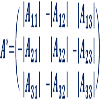 En este documento vamos a explicar cómo se calcula la matriz adjunta o de cofactores de una matriz y calcularemos la matriz adjunta de 2 matrices de dimensión 2x2 y 3x3. Temas de matrices: Matriz adjunta Suma de matrices Multiplicar matrices (1) Multiplicar matrices (2) Eliminación de Gauss (1) Eliminación de Gauss (2) Determinantes de matrices (1) Determinantes de matrices (2) Matriz inversa (1) Matriz inversa (por Gauss) (2) Matriz inversa (por determinantes) (3) Ejemplos del teorema de Ro...Àrea de coneixementContext educatiuTipus de recurs
 -
Gene therapy
 Material to learn about what Gene Therapy is and the main Viral Vectors used to carry it about.Àrea de coneixementContext educatiuTipus de recurs
 -
Sexually Transmitted Infections and Contraceptive Methods
 Material to revise what Sexually Transmitted diseases are and some examples of them, and to learn about different Contraceptive methods and their pros and cons.Àrea de coneixementContext educatiuTipus de recurs
 -
disoluciones
 Generalidades sobre disoluciones quimicas.Àrea de coneixementContext educatiuTipus de recurs
 -
LA MATERIA Y ENLACE QUÍMICO
 En el universo existe una serie de características que permiten identificar una sustancia y distinguirla de las demás; al conjunto de ellas se les llama propiedades de la sustancia las cuales suelen ser físicas o químicas, esto es de gran interés en el cotidiano, porque así podemos identificar cuando se presenta un cambio reversible (no se altera la materia), irreversible (transformación de la materia en una nueva sustancia), lo cual nos lleva a entender la realidad circundante.Àrea de coneixementContext educatiuTipus de recurs
 -
códigos QR y su aplicación didáctica
 Presentación sobre códigos QR y su aplicación didácticaÀrea de coneixementContext educatiuTipus de recurs
 -
Listening-Comprehension Exercise - Travel Guide: Paris (France).
 Listening Comprehension Exercise (Video on YouTube) about Paris (France) for students of 4 CSE (4 ESO).Àrea de coneixementContext educatiuTipus de recurs
 -
Principio de Huygens
 Método de análisis aplicado a los problemas de propagación de ondas. Se llama así en honor a los físicos Christiaan Huygens y Augustin-Jean FresnelContext educatiuTipus de recursColecciones
 -
Tipos de lentes (flash)
 En el visual se ve cómo se comporta la luz cuando atraviesa una lente bicóncava y una biconvexa.Context educatiuTipus de recursColecciones
 -
Viajes interesterales
 Concepto de viajes interestelaresContext educatiuTipus de recursColecciones
 -
Work-kinetic energy theorem
 The theorem of live forces establishes that the work carried out by the forces acting on a system, is equal to its kinetic energy.Àrea de coneixementContext educatiuTipus de recursColecciones
 -
Work carried out by a pendulum
 The following visual studies the work done by a pendulum: it is difficult to calculate as the force which acts on it varies constantly.Àrea de coneixementContext educatiuTipus de recursColecciones
 -
Work done streching a spring
 When we stretch a spring, the work we carry out varies as we stretch it. The following visual simulates the force exerted by a student on a spring. Choose a force constant for the spring and start the visual.Àrea de coneixementContext educatiuTipus de recursColecciones
 -
Work of friction
 The forces of friction, which oppose displacement, also carry out work when a body is moving. The work of friction is converted into heat. The greater the force of friction, the more force must be exerted to move the body. Verify how friction affects the displacement of some blocks.Context educatiuTipus de recursColecciones
 -
Wind energy
 The educational resource shows information about the concept windy energy and its advantages and its disadvantages.Àrea de coneixementContext educatiuTipus de recursColecciones
 -
Which moves faster? (II)
 Which UAM moves at a greater speed?Context educatiuTipus de recursColecciones
 -
Which moves faster? (I)
 Which URM moves at a greater speed?Àrea de coneixementContext educatiuTipus de recursColecciones
 -
What is work? (II)
 Work is one of the ways of transmitting energy between bodies. The following visual will help you understand the concept of work by modifying the force and the angle which it forms with the horizontal. Click on help to see the possibilities it offers.Context educatiuTipus de recursColecciones
 -
What is work? (I)
 The educational resource shows a visual about the work: in Physics, for there to be work there must be a force acting on an object and displacement of the object.Context educatiuTipus de recursColecciones